“Nonconformity Is the Beginning of the Story” — Quality in Healthcare
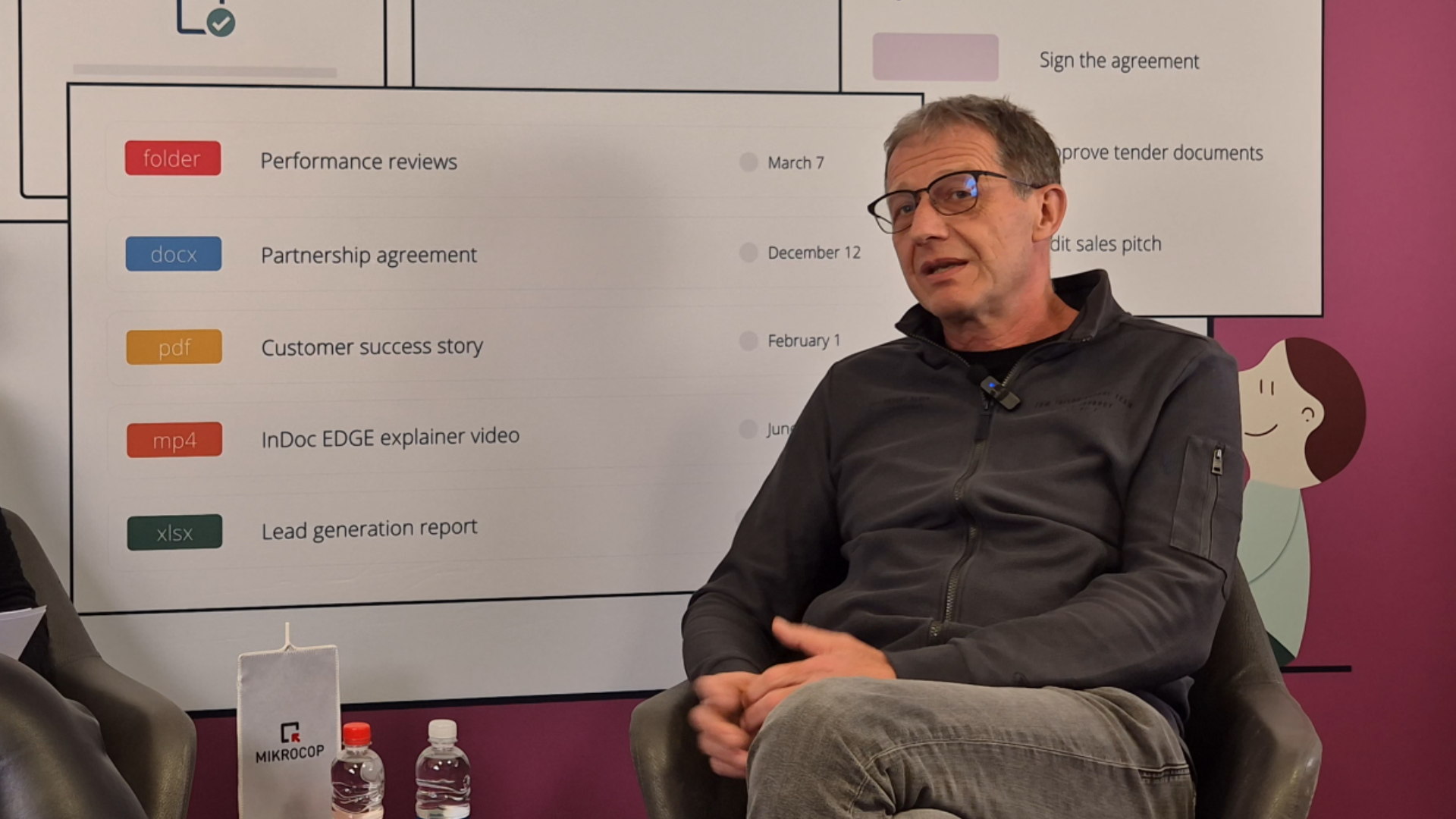
At Mikrocop’s DigiChat podcast, we hosted Dr. Aleš Rozman, long-time Medical Director of the Hospital for Gynecology and Obstetrics Kranj and a specialist in anesthesiology.
We spoke with Dr. Rozman about how quality management is handled in healthcare — from paper forms to digital systems, from recording nonconformities to building a culture of safety. He was one of the key contributors to the implementation of the digital solution InDoc EDGE at BGP Kranj. In the interview, he openly discusses the greatest challenges of healthcare digitalization, why people are always the main challenge, and why a nonconformity is the beginning of the story — not the end of it.
How do you see the progress of digitalization in Slovenian healthcare? Where are we today compared to Europe?
» It’s difficult for me to say where we stand compared to Europe. But I do know where we stand as healthcare providers. In recent years, we’ve made a major leap forward. A significant accelerator was the COVID epidemic, when within just a few weeks or months we introduced solutions that previously seemed impossible to implement.
» As a physician, sitting in the anesthesiology clinic today, I can instantly access all of a patient’s medical records. In our institution as well, practically all reports are now electronically signed and transferred to the central system, accessible to everyone. Compared to the time when nothing was available in the system, the difference is enormous.
Are the challenges of digitalization more related to technology, mindset, or organizational culture?
» In the end, the main challenge always becomes people. People such as IT specialists who listen to me when I present my processes to them. And on the other side, employees who need to be trained and helped to understand that this is a new way of working for them — and that this way of working is better, more transparent, and perhaps even safer for everyone.
» Digitalization is always demanding. You need to understand the processes, explain them to IT specialists in a meaningful way so they can truly digitalize them rather than simply transferring them into digital form. Then those processes must actually go through implementation and become part of everyday practice.

In healthcare, we often encounter the terms “deviation” and “nonconformity.” What do they mean?
» Nonconformity is exactly that — something unexpected that happens once and usually requires corrective action. For example, a hematoma after abdominal surgery — the surgeon must intervene.
» A deviation, on the other hand, can be understood as a variation from the standard. It is something non-standard but accepted — an alternative pathway when the standard one is not appropriate. Every institution must define which terminology it will use. What matters is that the quality system clearly determines how these events are named and managed. In our institution, we use the term nonconformity.
When does a nonconformity become an opportunity for improvement rather than just a mistake people want to hide?
» The words mistake and incident always carry a sense of blame. You are guilty. That is why, in quality management, we do not want to use them in that way. Nonconformity means that something happened unexpectedly, along a different path. Every such event should represent an opportunity for improvement. A nonconformity is the beginning of the story.
When BGP Kranj started digitalizing nonconformity management, did you begin with people, processes, or technology?
» I approached it based on the experience I had built over nearly a decade while managing quality in transfusion medicine. At one point, we identified an ethical nonconformity — blood components were being delivered to us, some remained unused, and we had to discard them. That ethical nonconformity led us to establish a system.
» First came corrective and preventive measures related to the nonconformities themselves. In the next step, a risk register was added. From all of this experience, when the moment for digitalization arrived, I generalized the approach across the entire institution.
At Mikrocop, we conducted a survey on nonconformity management involving 70 companies. One-third already have digitalized processes, one-third are halfway there, and one-fifth still work manually. In your opinion, why do some organizations still stick to Word and Excel?
» It is not easy to transition to digital solutions when you are used to one particular way of working. You receive a paper form, place it on a pile, and at the end of the year you count the pile and sort it out. Transforming that into a process and a digital solution is certainly a difficult step. Change is always difficult — both for those implementing it and for those who must adapt to it.

How can organizations prevent nonconformity management from becoming just an administrative task and keep it a living process of improvement?
» That is quite a difficult challenge. Everyone talks about quality, but it is difficult to ensure that it does not become merely documenting mistakes. What matters is that we genuinely work with nonconformities and risks, manage them properly, and maintain a culture of continuous improvement. I do not have a simple recipe.
A culture of safety is not something you create once and then forget about. It requires constant work and continuous development. Every person is an individual. Every team has its own dynamics. You cannot manage two teams in exactly the same way. Most often, the key lies in a personal approach, leading by example, and maintaining a positive mindset so that events are approached without blame.
If you had to summarize everything we discussed in a single sentence: what is the essence of quality management in healthcare?
» Healthcare professionals are used to treating people. A quality manager in healthcare, in essence, treats the processes within healthcare.
What advice would you give to those who want to build a culture of openness and learning from nonconformities?
» Record risks and do not give up. I do not have any particularly clever advice. Every time I approached a process from the beginning, I realized it could still be improved further. There is always room for another improvement. You simply have to persist.
» You can always be satisfied when you take a step forward. In the next cycle, you will take another step, make another change — but you can already be satisfied with the fact that you moved one step ahead.
From Conversation to Practice
Dr. Rozman’s experience is not merely a reflection on quality management. It is also the story of the journey BGP Kranj has taken — from manual processes to a unified digital system for risk and nonconformity management.
Listen to the full conversation with Dr. Aleš Rozman in the DigiChat podcast.
Want to learn more? Contact us!
MORE FROM MIKROCOP
Blog

Without Trusted Information, There Is No Trustworthy AI
Organizations want to integrate artificial intelligence into their everyday work. But this quickly raises an important question: How can AI be given access to business knowledge without compromising the security, compliance, and reliability of information?
Blog

AI Is Transforming HR. Is Your Document Management Ready?
HR has become a strategic business partner, a steward of talent, and a guardian of compliance—all at the same time. But does it have the right tools to fulfil these responsibilities? In most organizations, the answer is still no.
Blog

What Do We Gain by Digitalizing Contracts?
Digital contract management is no longer just a “nice to have” — it is becoming the foundation of modern business operations. Companies that still manage contracts in paper form or scattered folders often face delays, errors, and poor visibility.