AI Is Transforming HR. Is Your Document Management Ready?
HR has become a strategic business partner, a steward of talent, and a guardian of compliance—all at the same time. But does it have the right tools to fulfil these responsibilities? In most organizations, the answer is still no.
The gap between expectations and available tools is evident everywhere. And this is where companies often face what appears to be a technical question: “What kind of Document Management System (DMS) does a modern HR department need?”
The answer goes far beyond technology. It is a strategic decision.
1. From Personnel Files to a Strategic Source of Information
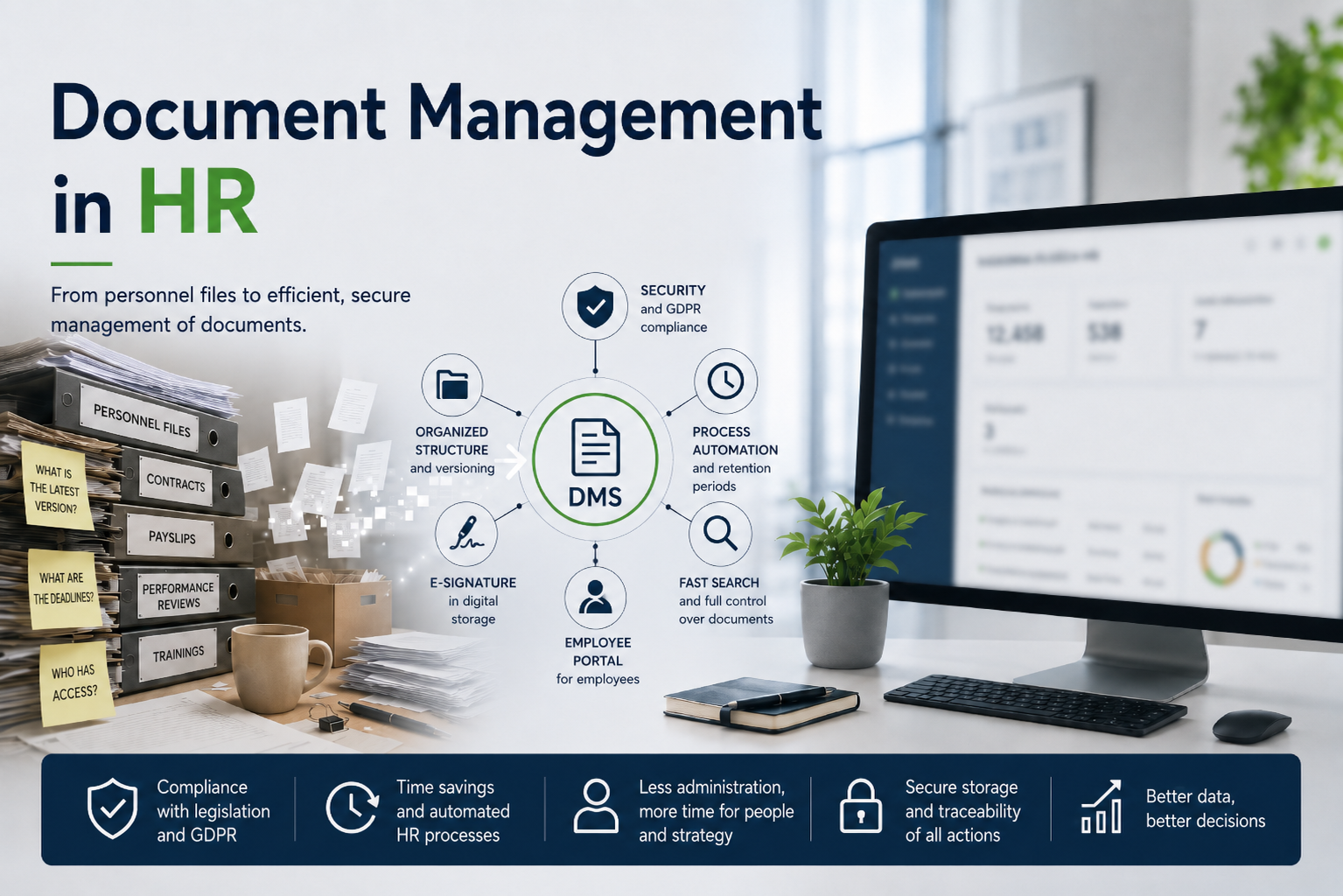
The term “personnel file” is deeply rooted in HR terminology. Our research revealed that it is still used by as many as 80% of Slovenian companies. Yet the word “file” unconsciously limits our thinking. It brings to mind folders and records that are opened when needed and closed once the task is complete. It suggests storage rather than value.
Modern HR departments need more than a “file”. They need a dynamic system that enables them to:
- instantly locate any employee document, regardless of when it was created,
- verify who accessed sensitive information and when,
- automatically manage document retention and disposal periods,
- provide employees with access to their own documents without placing additional demands on HR staff,
- electronically sign contracts and store them in compliance with GDPR requirements—immediately and without printing.
This is not a vision of the future. These capabilities already exist today, yet most HR departments are still not taking full advantage of them.
2. Three Strategic Roles a DMS Provides That an HRM System Does Not
Ensuring Compliance and Audit Readiness
GDPR compliance cannot be treated as a simple checkbox exercise. It requires organizations to actively manage access rights, audit trails, and retention periods for every document containing personal data. When an inspection or audit occurs, saying “we have everything under control” is not enough. You must be able to demonstrate who did what, when, and how. A document management system records this information automatically.
Accelerating HR Processes
In an organization with 200 employees, performance evaluations typically require around three hours per employee—equivalent to approximately 1,200 hours annually across all participants. By digitalizing workflows, introducing electronic signatures, and automating document archiving, organizations can significantly reduce the time required. Companies that have already digitalized these processes frequently report substantial reductions in administrative work and shorter performance review cycles.
Freeing HR to Focus on Strategic Priorities
Organizations that have implemented employee self-service portals often report a 20–30% reduction in routine HR requests. The time gained can then be invested where it creates the greatest value: talent acquisition, employee development, and organizational culture.
3. The Common Pitfall: Having a System Does Not Mean Having a Solution
Only 15% of Slovenian companies have fully digitalized employee files. The remaining 85% still operate in a hybrid or predominantly paper-based environment. Yet even among organizations that have adopted digital solutions, a common challenge remains: documents are scattered across shared drives, access permissions are poorly managed, and retention periods are not automated.
A true document management system is not simply a digital filing cabinet. It is a platform with built-in governance: who can access which documents, when records expire, which actions are traceable, and which processes are automated. Without this logic, digitalization does not create efficiency—it merely replaces paper-based chaos with digital chaos.
This becomes particularly problematic when sharing HR documents. Our survey revealed that more than three quarters of companies still distribute employment contracts in physical form, while nearly one fifth continue printing payroll documents. Not only is this inefficient, but when personal data is involved, it also represents a genuine security risk.
4. A New Perspective: DMS as Strategic HR Infrastructure
In organizations where HR truly operates as a strategic business partner, discussions about document management do not begin with the question, “Where should we store contracts?” Instead, they start with, “What infrastructure do we need to ensure that every HR process is compliant, traceable, and properly documented?”
This shift transforms the perception of a DMS from an IT project into a strategic HR investment. And it is a shift that more mature organizations are already making.
Interestingly, 88% of surveyed Slovenian companies believe their HR documentation is well protected against unauthorized access. Yet only 20% store these records in certified electronic archives. This gap between perceived and actual security is significant—and often becomes visible only when it is already too late.
5. AI Is Entering HR—But Only Where the Foundations Are in Place
The conversation around AI in HR is no longer optional. Chatbots for initial candidate screening, automated employee onboarding, intelligent document classification—these capabilities already exist. However, AI can only deliver value where data is structured, processes are clearly defined, and documentation is fully digitalized.
Without a well-organized digital archive, clearly defined workflows, and traceable access controls, AI has nothing reliable to build upon. Organizations investing in robust HR document management infrastructure today are laying the groundwork for the intelligent capabilities of tomorrow.
The question is no longer “Should we digitalize?” but rather “Where are we today, and what should our next step be?”
Digital transformation in HR is a journey, not a one-time project, and every organization is at a different stage. Some are still addressing the basics—converting paper files into digital records. Others are optimizing processes such as performance reviews or onboarding. The most advanced organizations are already asking a more strategic question: how can document infrastructure support better HR decision-making?
At every stage of this journey, the right document management system acts as an enabler rather than an obstacle. Organizations that understand this are not simply solving administrative challenges—they are building the foundation for HR excellence.
Want to learn more? Contact us!
MORE FROM MIKROCOP
Blog

Without Trusted Information, There Is No Trustworthy AI
Organizations want to integrate artificial intelligence into their everyday work. But this quickly raises an important question: How can AI be given access to business knowledge without compromising the security, compliance, and reliability of information?
Blog
“Nonconformity Is the Beginning of the Story” — Quality in Healthcare
At Mikrocop’s DigiChat podcast, we hosted Dr. Aleš Rozman, long-time Medical Director of the Hospital for Gynecology and Obstetrics Kranj and a specialist in anesthesiology.
Blog
What Do We Gain by Digitalizing Contracts?
Digital contract management is no longer just a “nice to have” — it is becoming the foundation of modern business operations. Companies that still manage contracts in paper form or scattered folders often face delays, errors, and poor visibility.