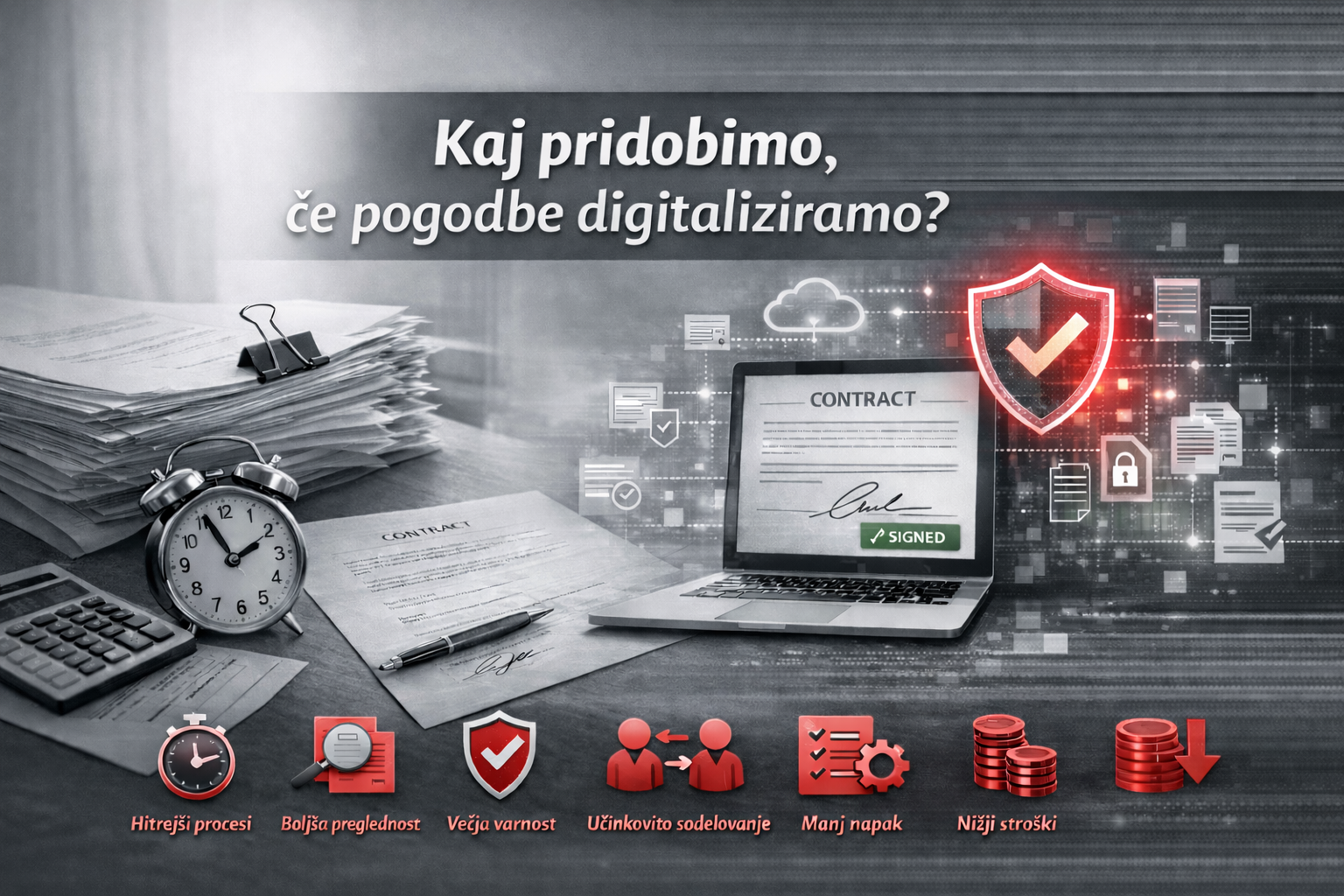
What Do We Gain by Digitalizing Contracts?
Digital contract management is no longer just a “nice to have” — it is becoming the foundation of modern business operations. Companies that still manage contracts in paper form or scattered folders often face delays, errors, and poor visibility.
By transitioning to digital contract management, an entirely different picture emerges — greater control, lower risks, and significantly more efficient processes.
1. Faster Processes and Less Administration
Digitalizing contracts enables the entire process — from drafting to signing and storage — to move much faster.
Instead of manually sending documents, printing, and scanning, contracts can be:
- created from templates,
- sent for review and approval,
- signed electronically.
This shortens processing times from days to hours or even minutes. At the same time, manual tasks are reduced, as systems allow process and task automation.
2. Better Visibility and Control Over Contracts
One of the biggest challenges of traditional contract management is the lack of transparency.
With a digital system such as InDoc EDGE:
- all contracts are stored in one place,
- they have a clear structure and metadata,
- fast content-based search is enabled.
Advanced search functions make it possible to find a document within seconds, significantly improving decision-making and productivity.
In addition, you always have insight into:
- the contract status,
- responsible persons,
- the history of changes.
3. Greater Security and Compliance
Digital contracts are not only convenient — they are also more secure.
Modern systems provide:
- access control (who can see what),
- an audit trail (who did what),
- protection of document integrity.
This means lower risks of misuse and better compliance with regulations (such as GDPR and eIDAS). Electronic signatures further ensure the legal validity of documents, enabling fully digital business operations without compromise.
4. More Efficient Team Collaboration
Contracts usually involve several people — legal teams, sales, and management. Digitalization enables:
- simultaneous document editing,
- real-time commenting and coordination,
- automatic notifications about changes.
This means fewer emails, fewer misunderstandings, and faster coordination. The result? Better-connected teams and faster decision-making.

5. Fewer Errors and Greater Standardization
With manual work, mistakes happen quickly:
- the wrong contract version,
- missing signatures,
- inappropriate terms and conditions.
Digital systems prevent this through:
- the use of templates,
- document versioning,
- controlled approval workflows.
Every change is recorded, every version is stored — resulting in greater reliability and lower risk.
6. Lower Costs and Higher Efficiency
Digital contract management also has a direct impact on costs:
- less printing and physical storage,
- less manual work,
- fewer mistakes and delays.
At the same time, companies optimize processes and improve operational efficiency. In the long run, this means better use of resources and more room for developing core business activities.
Contracts as a Strategic Advantage
Digitalizing contracts is not just a technological upgrade — it is a business decision. It brings companies:
- faster processes,
- greater transparency,
- better security,
- lower costs.
In practice, this means contracts no longer represent a bottleneck but instead become a support mechanism for company growth and development.
Want to learn more? Contact us!
MORE FROM MIKROCOP
Blog

Without Trusted Information, There Is No Trustworthy AI
Organizations want to integrate artificial intelligence into their everyday work. But this quickly raises an important question: How can AI be given access to business knowledge without compromising the security, compliance, and reliability of information?
Blog

AI Is Transforming HR. Is Your Document Management Ready?
HR has become a strategic business partner, a steward of talent, and a guardian of compliance—all at the same time. But does it have the right tools to fulfil these responsibilities? In most organizations, the answer is still no.
Blog
“Nonconformity Is the Beginning of the Story” — Quality in Healthcare
At Mikrocop’s DigiChat podcast, we hosted Dr. Aleš Rozman, long-time Medical Director of the Hospital for Gynecology and Obstetrics Kranj and a specialist in anesthesiology.